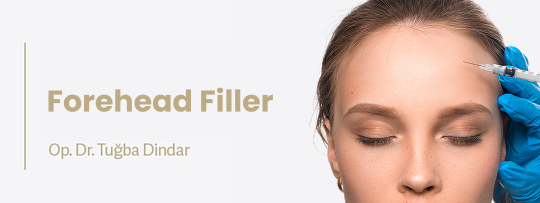
As we get older, fine lines and wrinkles gradually appear on the face. One of the areas where these lines become most noticeable is the forehead. Forehead wrinkles and expression lines can sometimes make a person look older than they actually are.
Fortunately, this concern can now be effectively improved with modern dermal filler treatments. With a forehead filler procedure, wrinkles and horizontal forehead lines can be softened, helping the face look smoother, fresher, and more youthful in a non-surgical way.
Forehead filler is suitable for both women and men, especially those who want to reduce the appearance of forehead lines and achieve a naturally rejuvenated look. While the results are not permanent, the treatment can be repeated regularly to help maintain a youthful appearance over time. Another advantage is that it is a quick procedure-often completed within minutes.
What Type of Filler Is Used for Forehead Filler Treatment?
The filler material used may vary depending on the practitioner and the patient's needs. In some cases, the treatment can be performed using fat taken from the patient's own body (typically from the abdomen or hips). This method is often described as fat injection with stem-cell support, and it aims to restore volume while improving the appearance of lines.
However, one of the most commonly preferred options is hyaluronic acid (HA) dermal fillers. Hyaluronic acid fillers are widely used in aesthetic medicine due to their safety profile and natural-looking results. During your consultation, you can learn which filler type is most suitable for your skin and goals.
How Is Forehead Filler Done?
In general, forehead filler can be performed using two main techniques. Most procedures are done through precise injection into targeted areas. The technique may slightly differ depending on the filler material used.
Forehead Filler with Hyaluronic Acid
With this method, the filler comes ready-to-use. The product is injected into the planned areas on the forehead, and the procedure is completed in a short time.
Forehead Filler with Fat Injection
In this technique, fat is first collected using liposuction, then processed and injected into the forehead. Compared to hyaluronic acid fillers, this method may take longer due to the preparation stage.
How Long Does Forehead Filler Take?
A forehead filler procedure typically takes around 30 minutes. In some cases, including preparation, the session may take up to one hour. Since it is completed in a short time, patients usually do not need to set aside a full day for the treatment.
A major benefit is that it does not require a long recovery process. This makes forehead filler an excellent option for those who do not want to take time off from work or daily life.
How Long Do Forehead Fillers Last?
The longevity of forehead fillers can vary depending on factors such as skin structure, metabolism, and filler absorption rate. On average, results may last around 1.5 years. After this period, the forehead may gradually return to its previous appearance.
Some individuals metabolize filler materials faster, while others retain results longer. However, regular maintenance sessions can extend the overall effect. Even after the filler has fully dissolved, patients often report that their forehead looks better than before the initial treatment.
Forehead Filler Prices
Many people looking to reduce forehead lines also wonder about forehead filler costs. Providing a fixed price can be misleading because pricing depends on several factors, including:
- The practitioner's experience
- The type and quality of filler material used
- The amount of product required
- Whether one session is enough or multiple sessions are recommended
A clear estimate is usually provided after a consultation and a simple facial assessment. In general, dermal filler treatments are often more affordable than people expect, especially when compared to surgical rejuvenation options.
Are There Any Side Effects of Forehead Filler?
Forehead filler is generally considered a safe aesthetic procedure with minimal side effects. In some cases, mild redness may occur right after the injection. This is normal and temporary.
Other significant side effects are not expected when the procedure is performed appropriately. For this reason, forehead filler is widely preferred among non-surgical facial rejuvenation treatments.
Who Can Get Forehead Filler?
People with visible forehead lines and wrinkles are typically good candidates for this procedure. However, there are a few important conditions:
Forehead filler may not be recommended if:
- There is an open wound in the treatment area
- Active skin conditions such as eczema or inflammation are present (these should be treated first)
Forehead filler is also generally not recommended during:
Additionally, individuals with blood clotting disorders should avoid filler procedures unless cleared by a physician.
When these criteria are met, forehead filler can be a highly effective way to achieve a smoother and younger-looking forehead.
How Many Times Can Forehead Filler Be Done?
There is no strict limit on how many times forehead filler can be performed. Once the effect starts to fade, the treatment can be repeated.
However, it is important to understand that dermal fillers do not stop the natural aging process. They mainly help reduce the appearance of fine lines and wrinkles. Over time, new wrinkles may form, and very deep lines can be improved but may not always disappear completely. Your physician can provide detailed guidance based on your skin condition.
Forehead Filler Near Istanbul: Why Tekirdağ Is a Smart Choice
For patients searching online for terms like "forehead filler near Istanbul", "Turkey aesthetics", or "non-surgical facial rejuvenation in Turkey", Tekirdağ offers a strong advantage. Tekirdağ is located very close to Istanbul, making it a convenient option for both local and international patients who travel to Türkiye for aesthetic treatments.
Procedure Process
Patients who have never had dermal fillers before may want to learn more about the forehead filler procedure and what to expect during the treatment. The process is simple, comfortable, and performed as an in-office, non-surgical aesthetic treatment.
- Forehead filler is not a surgical procedure and does not require general anesthesia.
- Before the injections, a topical anesthetic (numbing) cream is applied to the forehead area.
- This numbing cream helps minimize discomfort, preventing pain during the procedure.
- The selected dermal filler material is then carefully injected into the pre-planned areas of the forehead to target wrinkles and expression lines.
- Once the treatment is completed, patients can return to their normal daily routine immediately, with minimal downtime.
After the Procedure
After a forehead filler treatment, patients may wonder what the recovery period looks like. In general, forehead fillers are considered a minimal downtime procedure, and most people can return to daily life right away. Here are the key points to know after the injection:
- Mild redness at the injection site may occur after forehead filler.
- This redness usually disappears within the same day.
- In rare cases, bruising or swelling (edema) may be seen, but it is temporary and resolves completely.
- The procedure does not cause significant discomfort or fatigue, so it typically does not require resting at home or staying in a clinical setting.
- It is important to avoid any impact or pressure on the forehead area after the procedure.
- For the period recommended by your doctor, you should avoid makeup and cosmetic products on the forehead region.
- Once the filler effect fades at the end of its longevity period, there is no need to wait-the procedure can be safely repeated to maintain results.
If you would like to learn more about forehead filler injections, or if you want to request an appointment, you can contact us anytime.