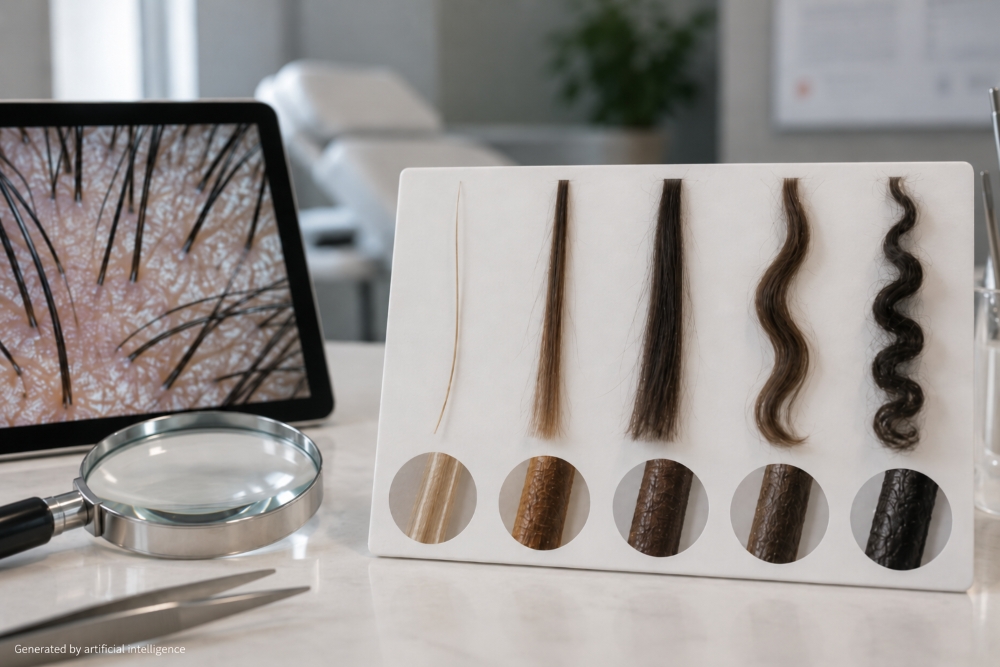
Hair characteristics are important in hair transplantation; in particular, the physical features of the hair follicles and shafts to be taken from the donor area are considered when evaluating the transplantation plan and the expected appearance. However, hair thickness or appearance alone does not determine whether the procedure is suitable or how many grafts can be harvested. While the scalp is considered the primary donor area, factors such as hair shaft diameter, curl pattern, color, growth direction, and follicular unit characteristics are assessed together.
The Role of Donor Hair Characteristics in Hair Transplant Planning
Donor hair characteristics are among the important factors considered in hair transplant planning. However, there is a critical point to keep in mind: hair structure alone does not determine procedural suitability, the number of grafts that can be harvested, or the final appearance. International practice guidelines recommend evaluating donor and recipient areas in terms of characteristics such as density, hair shaft diameter, direction, angle, color, and curl pattern.
Three concepts should be distinguished from one another. Hair thickness refers to the physical diameter of an individual hair shaft, while donor density refers to the number of hairs or follicular units within a specific area. Graft count refers to the total number of follicular units planned to be harvested and implanted during the procedure. Therefore, a donor area with thicker hair does not automatically contain a greater number of grafts.
| Feature |
Method of Evaluation |
Contribution to Interpretation |
| Diameter distribution |
Measurement in different areas |
Helps identify variability among hair shafts |
| Degree of curl |
Examination of the natural hair pattern |
Helps shape the implantation plan |
| Color contrast |
Comparison of hair and scalp tones |
Helps assess visual prominence |
| Growth direction |
Examination of follicular direction at the skin surface |
Helps reproduce the natural direction of hair growth |
| Follicular unit composition |
Assessment of the number of hairs per unit |
Helps determine the hair content of grafts |
Physical Characteristics of Donor Hair
The physical characteristics of donor hair require assessment of multiple factors together, including diameter, curl pattern, color, and the way the hair emerges from the scalp. Each of these characteristics may represent a different planning factor during transplantation.
Donor Hair Thickness and Diameter
Donor hair thickness is related to the diameter of the hair shaft, and thicker hairs may provide greater visual coverage at the same density. In this context, donor hair thickness refers to the diameter of the hair shafts in the donor area; it does not indicate the number of hairs or the number of grafts.
For this reason, when evaluating hair shaft diameter, not only the average value but also its distribution throughout the donor area may be considered. Hair thickness assessment in hair transplantation should therefore be evaluated separately from density measurement.
Straight, Wavy, and Curly Donor Hair
The characteristics of straight, wavy, and curly donor hair may be considered in hair transplant planning because of differences in the natural growth pattern of the hair. Curly donor hair may require a different approach to assessing length and direction because of the curvature of the hair shaft. During transplantation, it is important to anticipate the natural direction of the follicular unit and how the hair will lie within the recipient area.
When working with fine donor hair, the assessment of visual coverage may also differ because of the influence of shaft diameter. Thick donor hair may create more noticeable coverage with the same number of hairs; however, this does not by itself indicate a higher graft capacity.
Contrast Between Donor Hair Color and Scalp Tone
The contrast between donor hair color and scalp tone is a characteristic that may affect how visually prominent the hair appears. When there is high contrast between dark hair and a lighter scalp, scalp visibility may be more noticeable, while lighter hair may create a different visual effect. Therefore, hair with the same diameter and density may not produce the same visual appearance in individuals with different hair-to-skin color contrasts.
The Role of Follicular Unit Structure in Donor Area Assessment
Follicular unit structure is distinct from hair structure and refers to the natural anatomical grouping of one or more hair follicles. In hair transplantation, assessment of donor hair involves evaluating the physical characteristics of the hairs within these units, while follicular unit analysis also includes information such as how many hairs each unit contains and how the unit is structured. This distinction is important when interpreting graft count. The same number of grafts may not contain the same total number of hair shafts.
Importance of Donor Hair Growth Direction and Angle
The growth direction and angle of donor hair may be important both for harvesting follicular units and for placing the hairs in the recipient area in a way that is consistent with their natural growth pattern. When evaluating donor-area hair characteristics, the angle at which the hairs emerge from the skin and their orientation relative to one another may be examined.
Particularly with curly hair, the direction of the follicle beneath the skin may differ from the visible direction of the hair shaft at the surface. Considering these anatomical characteristics during surgical planning may be important for graft preparation and placement. The literature also emphasizes the importance of taking existing hair direction and angles into account when aiming for a natural-looking result in hair transplantation.
Trichoscopic Evaluation of the Donor Area
Trichoscopic evaluation of the donor area may provide more detailed information about density, hair shaft diameter distribution, and certain structural characteristics by examining magnified images of the hair and scalp. Trichoscopy can help identify differences that may be difficult to detect through visual examination alone. Research indicates that trichoscopy may be used to assess donor-area density and possible scalp disorders.
During this examination, not only the hair shafts but also the general appearance of the scalp and the characteristics of the donor area are evaluated. This can provide more detailed information about donor hair structure.
Comprehensive Evaluation of the Donor Area in Hair Transplant Planning
A comprehensive evaluation of the donor area in hair transplant planning requires assessment of hair characteristics together with density, follicular unit structure, and scalp condition. Donor hair density refers to the number of hairs or follicular units within a specific area and is a separate measurement from hair shaft diameter.
For example, a donor area with a high number of fine hairs and a donor area with fewer but thicker hairs would not be evaluated in the same way. Defining the boundaries of the donor area, considering the possibility of future hair loss, and planning the distribution of grafts that may be harvested are also included in the overall assessment.
For this reason, findings obtained during examination should be interpreted together, and outcomes should not be predicted on the basis of a single characteristic. This allows planning to be shaped more appropriately according to the individual’s anatomy, hair characteristics, and expectations.
| Planning Category |
Question Evaluated |
Why It Is Considered Together |
| Donor area mapping |
From which areas can grafts be harvested? |
To identify regional differences |
| Graft composition |
How many hairs are present in each graft? |
To interpret the total number of hair shafts |
| Recipient area characteristics |
How are the existing hairs distributed? |
To individualize the placement plan |
| Long-term planning |
To what extent can donor resources be preserved? |
To consider future options |
| Scalp condition |
Are there findings that require additional evaluation? |
To support development of the surgical plan |
In conclusion, while the physical characteristics of donor hair are important in hair transplantation, they are not the only determining factors. Hair diameter, curl pattern, color, and growth characteristics are assessed together with density, follicular unit structure, and scalp condition. Individualized planning should be carried out after examination and any measurements considered necessary.
Frequently Asked Questions
With the same number of hairs, thicker hair shafts may provide greater visual coverage; however, the result does not depend on hair thickness alone.
Hair transplantation may also be planned with fine donor hair. Assessment is carried out by considering hair shaft diameter, density, and other anatomical characteristics together.
Yes. Curl pattern may be considered when evaluating follicle direction and how the hair shaft is expected to grow within the recipient area.
No. Hair shaft diameter and the number of grafts that can be harvested are separate parameters.
No. Density refers to the number of hairs or follicular units, while thickness refers to the diameter of an individual hair shaft.
Trichoscopy may help provide a more detailed magnified assessment of hair and scalp characteristics within the donor area.