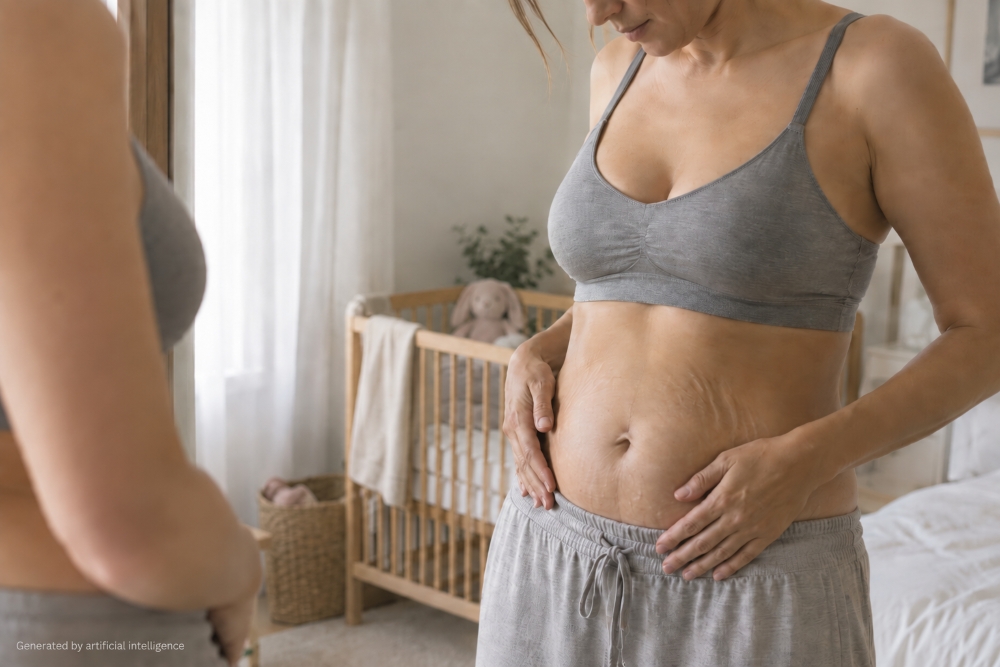
After childbirth, varying degrees of changes may occur in the skin, fat tissue, muscles, and connective tissue of the abdominal area. During pregnancy, the growing uterus and increasing abdominal volume cause the tissues of the abdominal wall to stretch, while hormonal changes may also affect the skin and connective tissue. After childbirth, some of these structures may gradually readjust over time. However, the recovery process is not the same for everyone. Therefore, it would not be accurate to attribute changes in the abdominal area to a single cause or to assume that everyone experiences the same process.
Changes in the Abdominal Wall During Pregnancy
During pregnancy, the abdominal wall stretches and changes shape to accommodate the growing uterus and increased intra-abdominal pressure. While the rectus abdominis muscles in the anterior abdominal wall adapt to the increasing abdominal volume, the connective tissue known as the linea alba, located between these muscles, may also stretch and widen. The skin and subcutaneous tissues likewise adapt to changes in volume during this period.
The degree of these changes may vary depending on the individual’s anatomical characteristics, connective tissue structure, and physical changes experienced throughout pregnancy. Therefore, the postpartum abdominal area does not have the same appearance or structural characteristics in every individual.
Main Changes That May Be Seen in the Abdominal Area After Childbirth
The main changes that may be observed in the abdominal area after childbirth can include structural changes in the abdominal wall, skin laxity, stretch marks, and changes in fat tissue. These factors are different from one another, and more than one may be present in the same individual.
Changes in the Abdominal Muscles and Linea Alba
After childbirth, the abdominal muscles and linea alba may gradually readjust following the stretching that occurred during pregnancy. Especially during the first weeks after childbirth, a natural decrease in the inter-recti distance may occur, while in some individuals this process may continue over a longer period. For this reason, when evaluating postpartum abdominal muscles, not only external appearance but also the function of the abdominal wall may be considered.
The linea alba is the connective tissue structure located between the two rectus abdominis muscles. During pregnancy, it may stretch and widen to accommodate expansion of the abdominal wall. After childbirth, readjustment of the postpartum abdominal muscles and surrounding connective tissue may vary from person to person.
Rectus Diastasis
Rectus diastasis is a condition associated with widening and thinning of the linea alba between the two rectus abdominis muscles. It is not defined as a tearing of the abdominal muscles. It may occur as the abdominal wall expands during pregnancy and may persist to varying degrees after childbirth.
It cannot be stated that every person who gives birth has clinically significant rectus diastasis. There are differences among studies regarding the threshold values used for definition and measurement. Therefore, it would not be appropriate to make a diagnosis based solely on personal observation. In clinical assessment, the structure and function of the abdominal wall and the individual’s current symptoms may be considered together.
Skin Laxity and Changes in Elasticity
Skin laxity and changes in elasticity may be associated with expansion of the abdominal skin and changes in connective tissue during pregnancy. The appearance of the skin after childbirth may vary depending on factors such as age, genetic characteristics, skin structure, and changes in abdominal volume during pregnancy.
Postpartum abdominal laxity is not the same anatomical condition as rectus diastasis. Skin laxity is related to the characteristics of the skin and connective tissue, whereas diastasis refers to the structural relationship between the linea alba and the rectus abdominis muscles. The two conditions may occur together in the same individual, but they should not be considered causes of one another or used as interchangeable terms.
Pregnancy Stretch Marks
Pregnancy stretch marks are linear skin changes associated with expansion of the skin and alterations in the connective tissue structures within the dermis. These stretch marks, known as striae gravidarum, may most commonly appear on the abdomen, hips, thighs, and breasts. In addition to mechanical stretching, genetic and hormonal factors are also thought to play a role in their development during pregnancy.
Postpartum abdominal stretch marks may change in color and prominence over time. Some may become paler after childbirth, and the same degree of change should not be expected in every individual. Therefore, it would not be accurate to generalize that stretch marks will disappear completely or remain permanently unchanged.
Changes in Abdominal Fat Distribution
Abdominal fat distribution may be affected by changes in body weight and body composition during and after pregnancy. However, the appearance of the abdominal area cannot be explained by fat tissue alone. Different anatomical layers, including the skin, subcutaneous fat tissue, muscles, fascia, and linea alba, should be considered together.
For this reason, the term postpartum abdominal sagging does not by itself indicate a specific anatomical cause. In one person, skin characteristics may play a more prominent role, while in another, changes in fat tissue or structural differences in the abdominal wall may have a greater effect on appearance.
| Anatomical Structure |
Main Change During Pregnancy |
Postpartum Assessment |
| Skin |
Adaptation to stretching and increased volume |
Elasticity and surface characteristics |
| Fat tissue |
Changes in volume and distribution |
Regional fat distribution |
| Rectus muscles |
Adaptation to expansion of the abdominal wall |
Muscle function and structure |
| Linea alba |
Stretching and widening |
Structural characteristics |
| Connective tissue |
Exposure to mechanical stretching |
Tissue elasticity |
Recovery Process of the Abdominal Area After Childbirth
Recovery of the abdominal area after childbirth is not a single-stage process that is completed immediately after delivery. Particularly in terms of the abdominal wall and linea alba, natural changes may continue during the first weeks. Research indicates that a natural reduction in inter-recti distance may be especially noticeable during approximately the first eight weeks, although individual differences may continue over the following months.
During the postpartum period, uterine involution, changes in fluid balance, and differences in body composition may also affect the appearance of the abdominal area. Therefore, it would not be appropriate to expect everyone to reach the same appearance at a specific month after childbirth. When evaluating postpartum abdominal changes, both natural changes over time and individual characteristics should be considered together.
Factors Affecting Postpartum Abdominal Appearance
Postpartum abdominal appearance may be influenced by factors such as the number of pregnancies, age, genetic characteristics, skin and connective tissue structure, weight changes, and the extent to which the abdominal wall expanded during pregnancy. The individual’s muscle and connective tissue characteristics before pregnancy may also be taken into consideration.
| Factor |
Potentially Related Structure or Characteristic |
| Number of pregnancies |
Repeated stretching of the abdominal wall |
| Age |
Skin and connective tissue characteristics |
| Genetic characteristics |
Elasticity and connective tissue features |
| Weight changes during pregnancy |
Volume of the skin and fat tissue |
| Weight changes after childbirth |
Body composition |
| Expansion of the abdominal wall |
Stretching of muscles and connective tissue |
| Existing muscle structure |
Functional characteristics of the abdominal wall |
None of these factors should be considered the definite cause of a particular abdominal appearance on its own. For example, having multiple pregnancies does not necessarily mean that pronounced laxity will develop. Similarly, individuals who experience a certain amount of weight change should not be expected to develop the same anatomical changes in the abdominal area.
If there is pain in the abdominal area, noticeable weakness, a complaint that affects daily movements, or another change that causes concern, consulting a healthcare professional may be appropriate. If rectus diastasis is suspected, a clinical assessment may also be required for diagnosis. The condition commonly referred to as postpartum abdominal muscle separation should not be identified as diastasis based solely on appearance.
In summary, the abdominal wall may continue to change for some time after childbirth following the stretching that occurred during pregnancy. Because the skin, fat tissue, muscles, and connective tissue may readjust at different rates, it is not possible to define a single recovery timeline for everyone.
Frequently Asked Questions
Recovery varies from person to person. Noticeable changes may occur during the first weeks, and the process may continue for a longer period.
No. Clinically significant diastasis does not occur in every person who gives birth.
No. The skin, fat tissue, and different structures of the abdominal wall may all play a role.
Yes. The color and prominence of stretch marks may change over time.
This varies from person to person, and it cannot be guaranteed that the pre-pregnancy appearance will be fully restored.