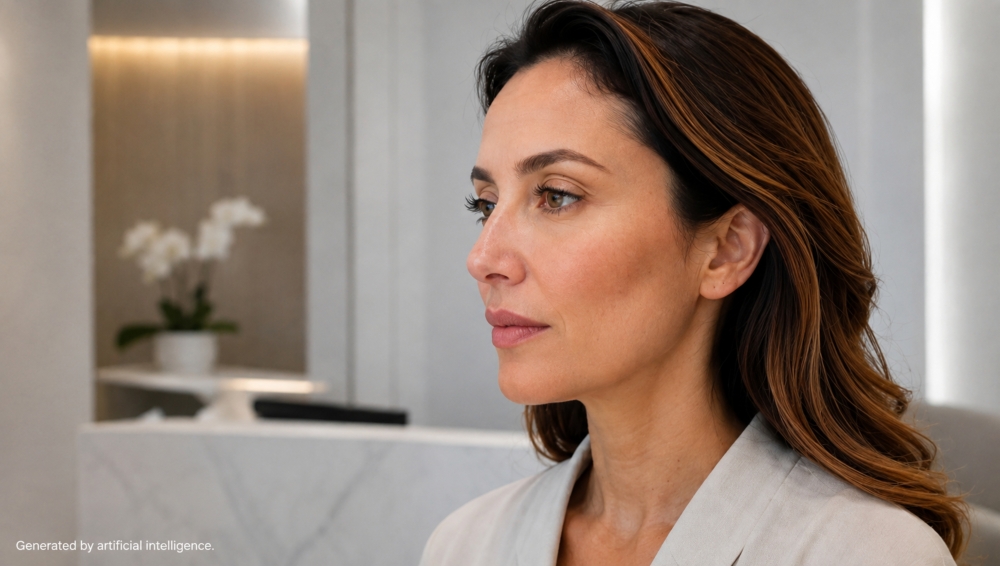
Ageing is a natural process, but facial changes do not develop at the same rate in everyone. Genetics, sun exposure, tobacco use, diet, stress and lifestyle habits can all influence how and when visible changes appear.
After the age of 40, changes in the skin are not limited to fine lines. Age-related changes in the deeper supporting structures of the face may also affect facial contours and overall expression.
What Begins to Change in the Skin After 40?
Changes that occur during the forties are not limited to the outermost layer of the skin. The skin, facial fat, connective tissues, muscles and bone structure all change over time.
One of the main biological processes behind skin ageing is a gradual slowdown in cell renewal. As skin renewal becomes slower, the skin may find it more difficult to maintain its previous brightness and smoothness.
At the same time, reduced collagen and elastin production may weaken the natural support systems that help the skin remain firm and flexible.
Changes that may become more noticeable with age include:
- Slower skin cell renewal
- Reduced ability to retain moisture
- Thinner or more delicate-looking skin
- Loss of elasticity
- Softer facial contours
- Uneven skin tone
- More visible effects of gravity
Factors That May Accelerate Skin Ageing and Habits That May Support Skin Health
| Factors That May Accelerate Ageing |
Approaches That May Support Skin Health |
| High levels of ultraviolet exposure |
Regular use of broad-spectrum sunscreen |
| Tobacco use |
Stopping tobacco use |
| Insufficient sleep |
Maintaining a regular sleep routine |
| An unbalanced diet |
Following a balanced diet that includes antioxidant-rich foods |
| Long-term stress |
Developing appropriate stress-management strategies |
| Air pollution |
Cleansing the skin appropriately at the end of the day |
| Frequent or uncontrolled weight changes |
Maintaining a stable and balanced weight |
This table summarises lifestyle factors that may influence how quickly signs of ageing become visible. Their effects may vary because each person has a different biological age, skin structure, medical history and level of environmental exposure.
What Are the First Visible Signs of Facial Ageing?
Early changes are often subtle rather than dramatic. Over time, small differences in certain areas may become more noticeable.
Signs of facial ageing are not limited to wrinkles. Changes in skin texture, volume, tone and facial contours may also be observed.
Fine Lines Around the Eyes
The skin around the eyes is among the thinnest and most delicate areas of the face. Because this area is involved in frequent facial movements, fine lines around the eyes are often among the first visible changes.
Lines on the Forehead and Between the Eyebrows
Lines caused by repeated facial expressions may gradually become visible even when the face is at rest. These changes are often associated with the early stages of visible wrinkle formation.
Reduced Skin Radiance
A slower skin cell renewal cycle may contribute to a duller or less radiant appearance. In some people, this change may become noticeable before deeper lines or wrinkles develop.
More Visible Pores
As collagen support decreases, pores may appear larger or more noticeable. This change is not limited to oily skin and may occur in different skin types as part of the ageing process.
Subtle Softening of Facial Contours
A less defined jawline or reduced distinction between the cheeks and surrounding facial areas may be among the early signs of facial ageing.
How Does Facial Volume Loss Affect Expression?
The appearance of a younger face is not determined by the condition of the skin alone. Facial fat, connective tissues, muscles and bone structure work together to support balanced facial contours.
As these structures change with age, the overall shape and expression of the face may also change.
Midface volume loss, in particular, may make the cheekbones appear less prominent and may contribute to a downward shift in the cheeks. This can affect not only facial shape but also how light and shadow fall across the face.
Volume loss does not usually begin in just one area. Small changes across different anatomical layers of the face may gradually combine and influence the overall appearance.
Possible effects of facial volume changes include:
- Reduced definition of the cheekbones
- A flatter appearance in the cheeks
- A more noticeable transition between the under-eye area and the cheeks
- Deeper lines extending from the sides of the nose towards the corners of the mouth
- Reduced definition of the jawline
- Changes in the natural oval shape of the face
What Are the Signs of Collagen Loss?
Collagen is one of the main proteins that helps support the strength, structure and elasticity of the skin. As collagen production naturally declines with age, changes may gradually occur in the skin’s texture, firmness and overall appearance.
Changes that may be associated with reduced collagen support can vary from person to person and may include:
-
Reduced skin firmness
-
Skin taking longer to return to its usual position after gentle movement
-
Fine lines becoming more visible over time
-
Reduced fullness in the cheeks
-
A more hollow appearance beneath the eyes
-
Thinner or more delicate-feeling skin
-
Reduced definition of the jawline
-
More visible pores
-
Make-up no longer appearing as smooth on the skin
-
Reduced radiance or vitality in the skin’s appearance
These changes are not specific to collagen loss alone. Skin hydration, sun exposure, genetics, changes in facial volume and other age-related factors may also contribute to their development.
Where Is Facial Sagging Usually Noticed First?
There is no single cause of facial sagging. Reduced skin elasticity, loosening of connective tissues, changes in the position of facial fat compartments and age-related changes in the underlying bone structure may all contribute.
Some areas of the face may show these changes earlier or more clearly than others.
Jawline
A softer or less defined jawline is one of the first changes many people notice. As the supporting tissues of the lower face change, the facial oval may gradually lose some of its previous definition.
Area Beneath the Chin
The transition between the chin and neck may become less distinct over time. Weight changes may affect this appearance, but they are not the only possible cause.
Cheeks
Age-related changes in facial support and the effects of gravity may contribute to a downward shift in the cheek tissues. This may make the midface appear flatter or less defined.
Eyebrow Area
Even subtle changes in eyebrow position may affect the appearance of the eye area and create a more tired-looking expression.
Corners of the Mouth
A downward change in the corners of the mouth may make the facial expression appear sadder or more tired, even when this does not reflect the person’s mood.
Is Skincare Alone Enough After the Age of 40?
A regular skincare routine can help support the skin barrier and maintain a healthier-looking complexion. However, the changes that develop after the age of 40 are not limited to the skin’s surface. For this reason, home skincare may not address every age-related concern.
Ageing can affect the epidermis, dermis, facial fat, connective tissues, muscles and underlying bone structure. Moisturisers, antioxidants and sunscreen may support hydration, skin-barrier function and protection from environmental damage, but they are not designed to reverse structural changes in deeper tissues.
This is why some people may continue to notice changes in their facial contours despite following a consistent skincare routine.
Many people search for ways to reduce visible signs of ageing. However, no single product or procedure produces the same outcome for everyone. An appropriate approach begins with identifying the skin’s current needs and considering the person’s health, skin type, lifestyle and expectations.
The following habits may help support skin health:
- Using a gentle cleanser suitable for the skin type
- Applying broad-spectrum sunscreen regularly
- Using moisturisers that support the skin barrier
- Considering active skincare ingredients that are suitable for the person’s age and skin characteristics, following professional advice when appropriate
- Maintaining adequate fluid intake and a balanced diet
- Avoiding tobacco products and limiting alcohol consumption
- Maintaining a regular sleep routine
Which Treatment Options May Be Considered for Facial Rejuvenation?
The effects of ageing differ from person to person. Facial rejuvenation should therefore be planned according to individual anatomy and concerns rather than through a standard treatment approach.
| Treatment Option |
Main Intended Effect |
Who May Be Considered? |
Typical Initial Recovery or Downtime |
| Botulinum toxin treatment |
May help reduce the appearance of expression-related lines by temporarily reducing activity in selected muscles. |
May be considered following a clinical assessment for people with noticeable expression lines on the forehead, between the eyebrows or around the eyes. |
Many people can return to routine activities on the same day. |
| Dermal fillers |
May be used to support areas affected by volume loss and help balance selected facial contours. |
May be considered for selected individuals with volume changes affecting areas such as the cheeks, chin, temples or around the mouth. |
Approximately 1–3 days |
| Collagen-stimulating treatments |
Aim to support gradual collagen production and improve selected aspects of skin quality over time. |
May be considered for suitable individuals with reduced skin firmness or elasticity following a professional assessment. |
Commonly around 2–7 days, depending on the treatment |
| Mesotherapy and skin-rejuvenation treatments |
May be offered with the aim of supporting skin hydration, texture or radiance. Outcomes and supporting evidence may vary depending on the product and technique used. |
May be considered for selected individuals with early changes in skin quality after discussing potential benefits, limitations and risks. |
Approximately 1–3 days |
| Laser treatments |
May be planned to address concerns involving skin texture, pigmentation, fine lines or overall skin quality. |
May be considered for people with suitable skin characteristics and specific concerns following an individual assessment. |
From several days to several weeks, depending on the type and intensity of treatment |
| Ultrasound- or radiofrequency-based treatments |
May be used to support skin firmness by delivering controlled energy to selected tissue layers. |
May be considered for some people with mild to moderate skin laxity. Suitability depends on the device, treatment area and individual anatomy. |
Often the same day or the following day |
| Thread lifting |
Aims to provide temporary support or repositioning in selected facial areas. |
May be considered for carefully selected individuals who do not wish to undergo surgery and have suitable anatomy. |
Approximately 5–10 days |
| Facelift surgery |
A surgical procedure intended to reposition sagging facial tissues and improve selected facial contours. |
May be considered for people with more noticeable tissue laxity who are medically suitable for surgery. |
Approximately 2–4 weeks of initial recovery |
| Neck lift surgery |
Aims to address tissue laxity affecting the neck and jawline. |
May be considered for medically suitable individuals with more noticeable looseness in the neck area. |
Approximately 2–3 weeks of initial recovery |
| Eyelid surgery — blepharoplasty |
Aims to address selected concerns such as excess eyelid skin or prominent under-eye bags. |
May be considered for suitable individuals with age-related changes affecting the upper or lower eyelids. |
Approximately 1–2 weeks of initial recovery |
The periods shown are general estimates rather than guaranteed recovery times. Healing and downtime may vary according to the procedure, treatment intensity, individual health, tissue characteristics and the clinician’s recommendations.
Some treatments may also involve risks, side effects or medical contraindications. These should be discussed before any procedure is selected.
Why Is Specialist Assessment Important When Planning Facial Rejuvenation?
Signs of facial ageing do not appear in the same way in every person. Even two people of the same age may have different levels of skin elasticity, facial volume, muscle activity, sun damage and anatomical support.
For this reason, decisions should not be based only on changes seen in the mirror, social media content or general recommendations found online.
During a clinical assessment, a qualified clinician may consider:
- Facial anatomy and proportions
- Skin quality and thickness
- Areas affected by volume loss or tissue laxity
- Facial muscle activity
- Previous treatments or surgery
- General health and current medication use
- The person’s concerns and expectations
- The possible benefits, limitations and risks of each option
This assessment can help determine whether treatment is necessary and which approach, if any, may be appropriate. Individual planning may also help avoid unnecessary procedures and support the preservation of natural facial movement and expression.
Key Takeaways
- Skin changes after the age of 40 are not limited to wrinkles. They may also involve facial fat, connective tissues, muscles and underlying structural support.
- Signs of facial ageing may appear differently around the eyes, cheeks, jawline and midface.
- Changes associated with reduced collagen support may include loss of firmness, reduced elasticity and softer facial contours.
- A regular skincare routine can support skin health but is not expected to reverse structural changes in deeper facial tissues.
- Facial rejuvenation options should be assessed according to the person’s anatomy, skin characteristics, health status and expectations.
- The aim of treatment planning should be to develop an individual, evidence-informed approach while preserving natural facial expression.
This content is provided for general informational purposes only. It does not replace medical examination, diagnosis or personalised treatment advice. A qualified healthcare professional should be consulted before deciding on any aesthetic or medical procedure.